Feeds:
Posts
Comments

Archive for the ‘Photojournalism’ Category

90ish days of summer

ARLINGTON, Va. — This morning, I shot my first photo assignment for The Washington Post.

Today is the Fourth of July, which means that 233 years ago, a group of colonial rebels signed a piece of parchment that confirmed their resolve to break from their parent country and create a new nation. This also means that today in the U.S. of A., people celebrate by eating as many German/Austrian hot dogs as they can stomach, setting off Chinese fireworks and watching (insert country of origin) parades.

So I shot Takoma Park’s 120th annual Independence Day parade for The Washington Post.

I originally thought about taking photos and recording sound so I could create an audio slideshow. Then I realized that maintaining consistent levels while recording a parade would be above my learning curve at this point. So instead, I asked my supervisor Dee if I could shoot the parade for a gallery. To ensure I wouldn’t be stepping on the Post‘s toes in doing so, she contacted the Post.

Before I knew it, I received an e-mail from one of the photo editors at the Post. Shooting the parade was a legitimate Post photo assignment.

Right now, I’m trying to figure out if posting photos (published and/or unpublished) on my Flickr and this blog would be within the Post‘s copyright and ownership policies, which is why you don’t see here any of the photos I took this morning.

But in the meantime, I can direct you to this washingtonpost.com photo gallery, which features my photos in the 9th and 18th spots (as of 8 p.m., at least — they’ll be adding more photos after the fireworks show tonight).

I hope I can share more photos with you on this blog and my Flickr! As it is, though, I’m so excited to have a photo byline again, and plan to pitch more photo ideas and hopefully get more opportunities and fieldwork this summer.

(Why the ARLINGTONG, Va. dateline? Because I’m in my last half-hour or so for the day in the washingtonpost.com newsroom.)

Read Full Post »

90ish days of summer

On June 21, Jeff’s dad took us to Great Falls (National) Park.

The park is an 800-acre plot divided by the Potomac River. Most of the park is in Virginia, and that’s the side we stayed on.

Panorama of the Potomac from the second viewpoint on the Virginia side.

Panorama of the Potomac from the second viewpoint on the Virginia side.

Let me tell you — Great Falls is the strangest national park I’ve ever been to.

As you may have read, Jeff, Esten and I visited four national parks and one state park this spring break, all of which were well west of the Mississippi River (Palo Duro Canyon State Park in Texas, Grand Canyon National Park, Arches National Park, Black Canyon of the Gunnison and the Great Sand Dunes). So far this summer, I’ve been to three national parks east of the Mississippi: Wolf Trap, the Great Smokies, and now Great Falls.

(Note: The National Mall and other “national parks” within the D.C. metro area don’t count as national parks — not in my book, anyway.)

When we hopped out of the car at Great Falls, I immediately noticed picnic tables. And volleyball pits. And people barbecuing and playing Frisbee and walking their dogs.

It looked a lot more like a big neighborhood park than a national park.

I guess what I’m saying is, I’m used to national parks being something like this: Two-lane highway, visitors center, barren parking lot, more driving, then WHAM-BAM! Grand vistas and landscapes are within sight.

Granted, the spring break trip was in the West and still during the cold season. And granted, the Grand Canyon did not have a barren parking lot.

Still. Great Falls weirded me out a bit. I’m not saying that its recreational offerings are bad — just not what I’d become used to.

That said, the Potomac was pretty grand.

Panoramic view of the Potomac from the third viewpoint on the Virginia side.

Panoramic view of the Potomac from the third viewpoint on the Virginia side.

Taken from the Fishermans Eddy -- not quite a sanctioned viewpoint, but not blocked-off, either. Its located between the second and third official viewpoints on the Virginia side.

Taken from the "Fishermans Eddy" -- not quite a sanctioned viewpoint, but not blocked-off, either. It's located between the second and third official viewpoints on the Virginia side.

As always, you can view more photos HERE.

Read Full Post »

90ish days of summer

I am home in Silver Spring, Md., safe and sound after almost three hours of transit. Had I left the washingtonpost.com office a half-hour earlier, I might not have been home yet.

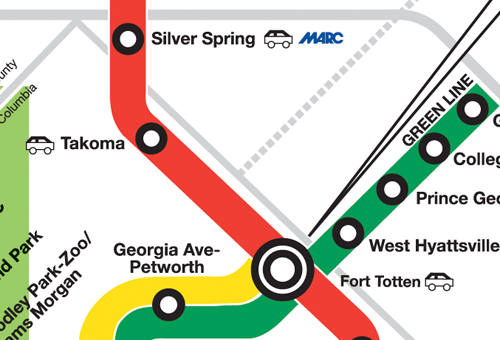
At 5 p.m., when I was logging off my work computers and saying goodbye to my supervising editor, two trains collided on the Washington Metrorail’s red line, between the Fort Totten and Takoma stations.

A detail of part of the red line, where the two-train collision occurred at 5 p.m.

A detail of part of the red line, where the two-train collision occurred between Fort Totten and Takoma at 5 p.m. today.

As you can see in the above map, the Silver Spring station is two stops past Fort Totten on the red line. According to the broadcast news, the two trains were headed toward D.C. — the opposite direction from which the train I would have been on would have been coming.

So even if I had left the office early, I wouldn’t have been on the trains that collided. But I would still have had to evacuate whatever train I were on, since according to the radio news reports, the entire red line is shut down.

Nevertheless, when I first heard about the collision — at 5:45 p.m. when I left a very congested Metro Center out of frustration — I didn’t know which direction the trains had been heading. So my first thought was, “I could have been on either of those trains.”

My second thought was, “I wish I’d been on or near either of those trains, and uninjured and with a camera.”

I read once that while most humans run from a crisis, only three kinds of people run toward it: the police, medical workers and journalists. I can’t honestly say I’m proud of the way tragedy and disaster attract journalists like bees to honey, but really, it’s a knee-jerk reaction. And if journalists can’t be at the scene, they often feel some dredge of guilt or regret that they couldn’t make it there.

That’s kind of what I’m feeling now, and every other time I’ve been close to a breaking news scene.

What else am I feeling? A lot of frustration with the Metro’s inability to communicate with commuters in the stations. It wasn’t until I emerged from the Metro Center station and called Jeff that I found out a major accident with multiple fatalities had occurred. I’m not saying that Metro station managers should have told commuters exactly what happened — but commuters should have been informed that the entire red line was shut down.

As it is, we were instead told to expect “major delays” and that a “turning incident” had occurred.

But I’m by no means educated enough on the D.C. Metro system and its history to say anything else about its failure to communicate and coordinate.

That said, I’m glad I’m safe and home, and my thoughts and prayers go out toward all the families affected by a tragedy that should never have happened.

Read Full Post »

90ish days of summer

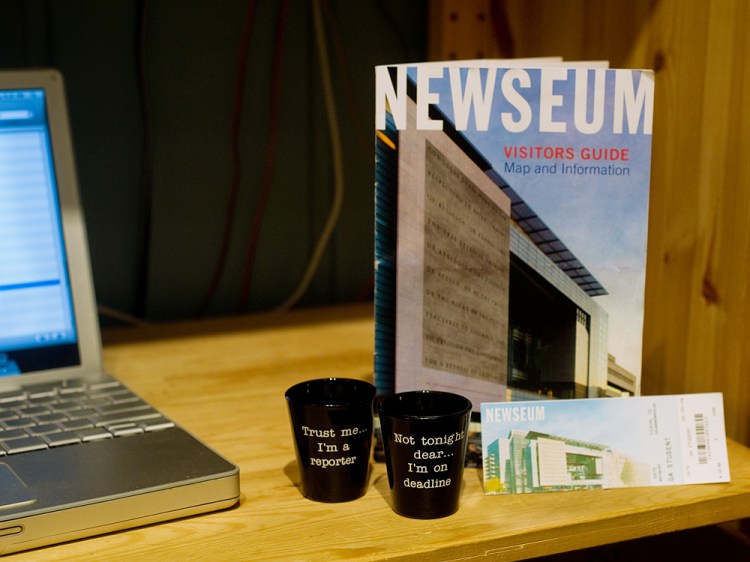
The shot glasses Jeff and I bought. Guess whose is whose.

The shot glasses Jeff and I bought at the Newseum store. Guess whose is whose.

Last week, I wrote a post called “Newseum: FAIL,” in which I scolded the Newseum for using what appeared to be a photoshopped photo on the cover of its visitors guide.

That was the most-read page or post on this blog, ever, except for my “About Chris Dunn” page. It attracted the most comments, too, even though I wrote an update/correction before any of the comments were submitted.

It still remains to be seen if my conclusion holds any water and if the photographer indeed edited that streetlight out. But I wanted to visit the Newseum to give it a fair assessement on the basis of its exhibits and not its visitors guide.

So last Saturday, Jeff and I went.

(more…)

Read Full Post »

90ish days of summer

Just a big ol’ dish of D.C. potpourri:

TODAY is my first sick day this summer. I’m not sure where I caught this minor bug, but I have a slight fever, my eyes hurt, my nose is runny, the back of my throat is tickly and I feel generally fatigued.

I think part of it has to do with the nature of my internship at washingtonpost.com: I spend almost entirely eight hours on the computer every day I’m in the office. Now, I am accustomed to spending inordinate numbers of hours on my laptop every day, but not eight hours at a time and day after day. So even though my monitor’s backlight is dimmed as I type this post, my eyes hurt just looking at it.

TODAY is also roughly the 20th anniversary of the crackdown in Tienanmen Square. I say “roughly” because the crackdown began on the evening of June 3 and ended sometime on June 5.

So much has already been said about how the Chinese government has deleted the crackdown out of its history books and shut down foreign news Web sites and other sites such as Flickr and Twitter, so I won’t add redundant noise to that conversation. Suffice it to say that of course, as a journalist in the Western hemisphere and a fan of the First Amendment, I think it’s despicable that the flow of information and the people’s inherent right to protest and free press are being disrupted and restricted.

Some interesting links relating to Tienanmen Square:

TOMORROW, I will be at the office at 8:30 a.m. to do a special gallery, but I’ll be getting out early. Some other interns — from the Post and other news outlets — and I will be going to the Sculpture Garden for wine and jazz during tomorrow’s happy hour!

Read Full Post »

90ish days of summer

Today was my first day as a photo/multimedia intern at washingtonpost.com.

After the intern orientation wherein all 20-something interns for WP.com, Express and the Slate Group learned some basic facts about the company, etc., we split up and spent the rest of the day with our departments and supervisors.

I have worked in two newsrooms before — at the Maneater student newspaper and at the Missouri statehouse bureau for The Columbia Missourian — but was in for a surprise today when I got to know the WP.com newsroom a little more. For one thing, it’s very quiet, and only about half the chairs in the multimedia and metro sections of the newsroom were occupied.

For another, I learned pretty quickly that, as far as photo at the .com goes, they take what’s given to them (by other .com people or the print Post) and work to put it on-line. In the other newsrooms in which I’ve worked, the pace was almost always frenetic and frantic. Reporters and photographers alike were shuffling or rushing in and out: in to produce, submit or edit content and out to get that content. Unless it was a slow news day, the newsrooms were always a little loud and fast-paced.

But the WP.com newsroom — again — is quiet. And the photo editors wait to receive requests and content before they process anything. It’s unlike any newsroom I’ve encountered (to be fair, I haven’t encountered that many).

The bottom line is, unless I take my own initiative on projects and stories I want to pursue, my responsibilities would consist mostly of working on Faces of the Fallen, putting photo galleries together and fielding photo requests.

My plan for the summer? Get as much work and experience in the field as possible, but get some more experience at the desk and in the newsroom, as well.

My supervisor Dee seems very open to my both spending time in the newsroom and taking initiative with stories (as long as I don’t tread on the print Post‘s toes), which I definitely appreciate and am excited about.

Now I just need to figure out what I want to do!

Read Full Post »

90ish days of summer

Okay — the Newseum itself is not a failure.

The last time I visited the Newseum was in 2001, and that was before it moved and upgraded to its current location on Pennsylvania Avenue. So I can’t really qualify the renowned journalism museum as a failure if I haven’t even visited the new facility (yet).

More accurately, the Newseum visitors guide is a failure.

Here’s the cover:

The cover looks nice. It’s got D.C. traffic going through on Pennsylvania Avenue. It’s got some nice evening light. Most importantly, it’s got the First Amendment on a slab for everyone to see.

Unfortunately, the cover is a gross misrepresentation of how the Newseum actually appears.

I’ve got proof:

This photo was taken at 16mm (a very wide focal length), from the median of Pennsylvania Avenue.

This photo was taken at 16mm (a very wide focal length), from the median of Pennsylvania Avenue, on May 21.

What’s the big deal?

There is a streetlight RIGHT IN FRONT OF THE FIRST AMENDMENT.

There’s almost no way to avoid that damn streetlight. Here’s the only shot I could get of the First Amendment without that streetlight slicing into it:

Also taken at 16mm.

Also taken at 16mm.

But somehow, the photographer who shot the cover of the Newseum visitors guide didn’t get the streetlight in his photo.

Jeff and I discussed the matter when we first saw the visitors guide and noticed the streetlight was missing. We considered that perhaps the cover was an artist’s rendering, not unlike those that architects and designers draw up before a building is constructed.

But then we saw the detail in the background of the photo (example: the leafless tree, the appropriate exponential spacing between the time-elapsed cars), which you can view for yourself here. Then we searched the brochure for photo and other credits, which we found on the inside of the back cover. According to those credits, “Newseum exteriors, Annenberg Theater, Pennsylvanue Avenue Entrance, Today’s Front Pages” are by a Sam Kittner.

I googled Sam Kittner and found that he is definitely not an architect or illustrator, but rather a photographer who relies heavily on exposure trickery and post-production editing. The cover is definitely a photograph and not an illustration or artist’s rendering.

It is then very clear that the absence of a streetlight in the Newseum’s visitor guide cover is possible in only two ways:

  1. Kittner took the photo before the streetlight was installed.
  2. Kittner edited the streetlight out after taking the photo.

Option (1) is possible… except also according to the inside of the guide’s back cover, the guide was printed or at least final-edited in March 2009. So unless the city were doing some streetlight renovations before Kittner’s deadline for the March 2009 publication, the only option left is (2).

Therefore, I conclude that the front cover of the visitors guide to a first-class journalism museum has been photoshopped to remove a streetlight that in reality stands in front of the First Amendment.

If that’s not a glowing demonstration of photo editing ethics on a journalism museum publication, I don’t know what is.

What a shame.

  • UPDATE (11:18 p.m. EST, May 25, 2009)

Okay, I stand corrected.

Option (1) appears to be the winner here.

As Joel has pointed out using the below image, the streetlight was not installed until at least shortly after the Newseum’s new facility was completed.

So perhaps Kittner’s photo on the museum’s visitors guide cover was taken before the streetlight was installed. At this point, I’m not going to offer any further speculation on that matter.

On a related note, a Twitter debate ensued my blog post, and several other MU journalism students (@mcavanah86, @jmsummers and @pfal) argue that the visitors guide is essentially advertising and that using photoshopped images is permissible for advertising.

I don’t disagree with that. But if Kittner’s photo were edited, I don’t think a journalism museum should have used it. Commercial purposes or not, a journalism museum should uphold the principles on which the journalism profession is based — and that includes not using photos with objects edited out of them.

Read Full Post »

Today, I definitely felt like a member of the Capitol press corps because today was the first time I spent a long period of time in the state House press gallery.

I also took photos to mark the closing day of the legislative session. Here are a few of them:

On closing day of the 95th General Assemblys first regular legislative session, Rep. Maria Chappelle-Nadal easily had the tallest stack of paper on her desk.

On closing day of the 95th General Assembly's first regular legislative session, Rep. Maria Chappelle-Nadal easily had the tallest stack of paper on her desk.

Minority Floor Leader Paul LeVota and Majority Floor Leader Steven Tilley share a fun moment in the rear of the House chamber.

Minority Floor Leader Paul LeVota and Majority Floor Leader Steven Tilley share a fun moment in the rear of the House chamber.

At the close of session, state representatives threw their papers into the air (a tradition).

At the close of session, state representatives threw their papers into the air (a tradition).

A family walks around the statehouse rotunda after the legislative session adjourned.

A family walks around the statehouse rotunda after the legislative session adjourned.

Members of the press set up equipment for Gov. Jay Nixons press conference.

Members of the press set up equipment for Gov. Jay Nixon's press conference.

A few more photos can be viewed at my Flickr page.

And with that, I close the door on this part of my life. Next semester, I’ll be back a few times, but certainly not on a regular basis or for day-to-day reporting — and anyway, there’s no session in the fall.

Tomorrow, I begin a new chapter of my life: I am going to Washington, D.C.!

Read Full Post »

Five weeks, countless hours of shooting and editing, who knows how much equipment and four very tired photojournalism students later, our audio slideshow is finally done.

As I’ve previously blogged, my group for the final multimedia project in Advanced Techniques in Photojournalism chose to highlight Hulett House Gym, a mixed martial arts gym representing Columbia in the Midwest Fight League. We photographed their practices in their gym, shot and recorded audio at the April 10 Battle at The Blue Note X, recorded interviews with the gym’s founder/trainer and two fighters and finally pieced everything together in about 15 grueling hours.

David has posted the Soundslides presentation on his Web site. Unfortunately, WordPress doesn’t allow me to embed Soundslides files (as far as I know, anyway), so please click HERE to view our slideshow.

Read Full Post »

JEFFERSON CITY, Mo. — On Saturday noon, I will be in Washington, D.C., with ten days to spare before my internship at washingtonpost.com begins.

This means I have four-ish days to write two articles, do an audio slideshow, complete the final group project for Advanced Techniques in Photojournalism, take my sociology final exam and pack up everything in my room/kitchen. In addition, I’ve scheduled coffee and meetings with about four or five different people throughout the week.

But in five days, I’ll be in Washington, D.C., where I’ll begin 92-96 days of summer (depending on my end date). Hence, “90ish days of summer” will be the running title/motif.

I haven’t had time yet to determine specific goals for this summer. Right now, I’m waiting for the Missouri Senate to adjourn so I can report on a 6 p.m. Senate committee hearing. But that doesn’t mean I haven’t started thinking and daydreaming about Washington.

Things to look forward to on this blog in the next few days:

  • Reflection on the 95th Missouri General Assembly’s first regular session
  • Reflection on reporting on abovementioned legislative session
  • Goals for the summer

In the meantime, I’m going to do my best to keep my head above water in this final week in Missouri.

Read Full Post »

I’ve got to admit, working the White House beat is vastly intriguing to me.

I’ve already pondered whether I would accept the position of White House photographer if offered the job. (Would I? Not quite sure, but leaning toward “yes.”) I enjoyed Ana Marie Cox’s “spring cleaning” column in The Washington Post about “why we should get rid of the White House press corps.” (Do I agree with it? Cox has some valid points, but I think the White House press corps still serves an important function.)

Now, as has been reported in the past few days, White House photographer Pete Souza has opened a Flickr account for the White House.

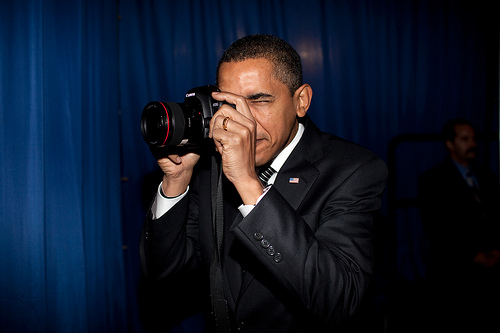
Pres. Obama apparently does not know how to hold a DSLR, but I'm not going to hold it against him. And, as you'll read further in this post, I'm not sure how to attribute this photo. Copyright 2009 by Pete Souza?

Pres. Obama apparently does not know how to hold a DSLR, but I'm not going to hold it against him. And, as you'll read further in this post, I'm not sure how to attribute this photo. Copyright 2009 by Pete Souza?

The vast majority of the 310 photos uploaded thus far were placed online on April 28, just before Pres. Obama marked his 100th day in office. It appears that Souza will keep the Flickr stream live, at least perhaps on business days, as his last upload was Friday, May 1.

Because I’m curious (read: nosy), I checked Souza’s EXIF data on his Flickr photos.

(more…)

Read Full Post »

The weather this week has been pretty miserable. Fortunately for Joel, Michelle, Ivy and me, we completed our “painting with light” assignment on the one night it hasn’t rained yet this week (Tuesday).

Painting with light? Huh?

It’s a pretty fun technique wherein you…

…make a photograph at night or darkened rooms, utilizing time exposure with light added to reveal something that otherwise would be unobservable at this time of day. Examples are unlit monuments, buildings or features of the landscape; movement of machines, people or animals; and illustrative or imaginary concepts and constructs. This is a photograph which is really a picture of light — because there would be no picture without the light.

Originally, we wanted to photograph the Renz Correctional Center — a women’s maximum-security prison outside of Jefferson City that was discontinued after flooding in 1993. But the property owners weren’t too keen on letting us on-site, much less in the dark.

So Michelle contacted the superintendent of Ha Ha Tonka State Park, which is about two hours south of Columbia and has castle ruins.

That’s right. Castle ruins. In Missouri.

You can read about why the hell there are castle ruins on a cliff in the middle of Missouri if you click HERE.

Anyway. Although Nancy the superintendent was initially reluctant to allow us to stay in the park after dark, which is when the gates are locked, she gave us permission to remain until 10 p.m.

We arrived at the park at dusk, when we could explore the castle ruins and scope them out. We also checked out the water tower, an old stone construction that is on the other side of the parking lot and about half a mile away from the ruins.

So here’s what we did: We could see the water tower from the ruins if we stood at a certain point near the ruins’ balcony. Joel had two-way radios with him, so we decided that one team of two people would remain at the ruins with the camera and a few strobes, and the other two people would go to the water tower. This way, we could light up both the castle ruins and the water tower within the same frame.

The exposures averaged about three minutes apiece. Ivy and I illuminated the water tower using strobes, and Michelle and Joel lit up the castle ruins and “ghosted” Michelle with strobes. It was a lot of fun, although we had a few scares involving bats, howling dogs in the distance and the superintendent’s surprise visit.

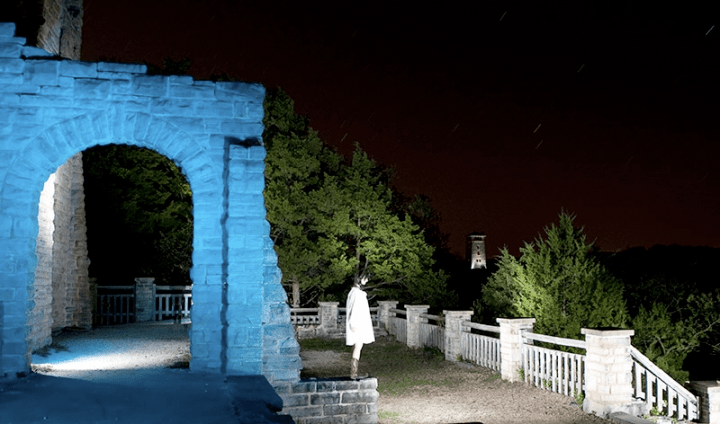
Here’s the result, which I screen-captured from Joel’s blog:

High on a hill in Ha Ha Tonka State Park, Mo., it's easy to imagine that ghosts might haunt the ruins of the old Snyder mansion, built by a wealthy Missouri businessman who died long before his dream retreat was completed. The castle-like structure was gutted by fire in 1942, while the nearby water tower survived until vandals set it ablaze 34 years later. Photo ©2009 by Joel Kowsky.

High on a hill in Ha Ha Tonka State Park, Mo., it's easy to imagine that ghosts might haunt the ruins of the old Snyder mansion, built by a wealthy Missouri businessman who died long before his dream retreat was completed. The castle-like structure was gutted by fire in 1942, while the nearby water tower survived until vandals set it ablaze 34 years later. Photo ©2009 by Joel Kowsky.

We were at the park for about two hours and only got seven frames. But hey — we had a concept, and we were able to lit up two structures, one of which was half a mile away from the other. I think we did pretty well.

By the way — Ha Ha Tonka State Park is beautiful. I highly recommend that anyone in the mid-Missouri area take a day trip there.

The park is also where Ha Ha Tonka the band gets its name. (Read the band’s reasoning here.) No one paid me to say this, but I really enjoyed the band’s performance as one of the opening acts for the Avett Brothers in the last Summerfest 2008 event in Columbia. If you like the Avett Bros. or a hard-to-describe mix of country, blues, rock and college band-esque music, you should definitely check out Ha Ha Tonka.

The end.

(Thanks to Michelle for the idea for this post’s subject!)

Read Full Post »

I am finally starting to overcome my apprehension about using strobes on the field!

I never really articulated this apprehension in this blog. Basically, at the beginning of this semester, I was horribly squeamish about using my strobe out in public because (gulp) I have this irrational fear of being perceived as an Asian tourist loaded with fancy camera gear.

Our TA in Advanced Techniques in Photojournalism told me I have to overcome this fear, which I knew, and suggested that I capitalize on the possibility of being perceived as an Asian tourist. Meaning, I should let myself loose and let people think I’m an Asian tourist, which would let me get away with using every piece of equipment in my bag.

I’m not quite over this fear. But I’m getting there.

For our latest assignment in the class, we were to use rear-sync curtain flash and panning movement to create a blended image:

Working with artificial constant source light (tungsten or fluorescent). Shoot people in an active situation and blend your strobe with the existing artificial light — being sure to think about the color temperature of that light and using the appropriate gel so the image is color correctable. Use of a slow shutter sync combined with panning or other cameras or subject movement to convey a sense of movement or action.

So I shot a drag show at MU.

It wasn’t nearly as elaborate, technical or hilariously raunchy as last year’s affair. The show was in a common area of Memorial Union, where the overhead tungsten lights were dimmed and there were no stage lights. Which was unfortunate for me, since there was very, very little artificial constant source light with which I could blend my flash.

But the show was still fun to shoot. I set my white balance for tungsten, gelled my flash accordingly, got my exposure right, set my flash for rear-sync curtain and fired away.

Here’s my select:

Columbia College student Wayne Boykin II performs as drag queen Amanda Lay at a drag show in Memorial Union on April 18. Boykin was crowned MUs Miss Diva 2009.

Columbia College student Wayne Boykin II performs as drag queen Amanda Lay at a drag show in Memorial Union on April 18. Boykin was crowned MU's Miss Diva 2009.

I learned pretty quickly that using the blending technique is a hit-or-miss deal. Whether I caught a good moment seemed to rely on how well I could anticipate a good moment in time to snap the shutter and trigger the rear-curtain flash so the flash’s light would stop the drag queen/king’s action in that moment I anticipated.

Make sense?

Thought so!

Read Full Post »

Let’s take a break from all the spring break roadtrip photo blog posts I’ve been putting up. Here’s my latest assignment for Advanced Techniques in Photojournalism: multiple flash.

Okay, I have to admit: I was TERRIFIED of having to use multiple flashes for this assignment.

The assignment:

Team up to assist each other in photographing an active situation using at least two strobes, one of which should be slaved or fired remotely. Just about anything can be fired using multiple flash, but good candidates for this assignment are things like sporting or cultural events, dance rehearsals, fashion shows and competitions — term projects.

Originally, my partner Matt and I were going to strobe up a practice at Hulett House (more about them in this blog post), as part of our group’s final project. But I wasn’t feeling well, and he had a paper he had to write anyway. So we ended up meeting on Monday — the night before the assignment was due, of course — and trying to figure out what to do.

After a stint at Capen Park didn’t work out and calls to other places didn’t go through, we ended up at Billiards on Broadway, where a few groups of people were playing pool. We chose to photograph Mike Smith, Chris Schulz and John Stone, who played several games. Fortunately for us, they didn’t mind being flashed with three strobes as they struck out billiard balls.

That’s right. Three strobes.

For my shots, here’s what I did:

  • I had an off-camera strobe (my 580EX II) attached via my shoe cord. Set on manual mode, this usually served as my key light. If I didn’t want it to be my key light, I’d simply aim it a little higher to trigger the other two strobes, which were optically slaved.
  • We had a Mini Morris, which is an optical slave whose power can’t be adjusted. Because of that, we simply sat it on nearby tables or the bar. Depending on the angle of my shot — which depended on where the players moved around the table — the Mini Morris acted as a backlight for some photos, a key for others and a side/fill for still others.
  • Matt set his strobe to act as an optical slave, and he would move around the table to accommodate my lighting needs — either to fill or highlight my shots.

Here are the three runner-ups, with explanations why I didn’t choose them as my select.

    While I like that we can see Mikes eye and utter concentration here, we can also see Matts flash in the lefthand side. Combined with that and the Mini Morris, the highlights in left side of the photo are blown out.

While I like that we can see Mike's eye and utter concentration here, we can also see Matt's flash in the lefthand side. Combined with that and the Mini Morris, the highlights in left side of the photo are blown out.

I like this photo. Its a bit dramatic, which I really dont mind. And I dont mind that you can see the Mini Morris in the righthand side (sitting on the bar). But I dont think Rita or Catalin would appreciate it, so this ones out.

I like this photo. It's a bit dramatic, which I really don't mind. And I don't mind that you can see the Mini Morris in the righthand side (sitting on the bar). But I don't think Rita or Catalin would appreciate it, so this one's out.

Disclaimer: I would have cropped this photo if it were my select. That said, its not my select because the red-striped ball is blown out and the yellow-striped ball in the foreground isnt lit well enough.

Disclaimer: I would have cropped this photo if it were my select. That said, it's not my select because the red-striped ball is blown out and the yellow-striped ball in the foreground isn't lit well enough.

So what does my select image look like? It’s not perfect, by any means, but I think it has the best combination of technique and composition.

Caption: MU student John Stone gets ready to strike the ball in a game of pool at Billiards on Broadway on April 20. Billiards on Broadway was previously located on Ninth Street. My only criticisms: You cant see Johns eyes, and the highlights in the lower righthand corner are a bit blown.

Caption: MU student John Stone gets ready to strike the ball in a game of pool at Billiards on Broadway on April 20. Billiards on Broadway was previously located on Ninth Street. My only criticisms: You can't see John's eyes, and the highlights in the lower righthand corner are a bit blown.

Overall, I feel a lot more comfortable with using multiple flashes. At first, it was pretty hit-and-miss, but I think Matt and I did a fairly decent job by the end.

Read Full Post »

I photographed the Midwest Fight League‘s Battle at The Blue Note X on Saturday as part of the final group project for my Advanced Techniques in Photojournalism class.

It was not a piece of cake.

For our group project, we have shot a few practices for Hulett House fighters. Hulett House was founded by Rob Hulett and is Columbia’s representative in the Midwest Fight League — which was also founded by Rob Hulett. The big tournament was this Saturday, so naturally all four of us went there to photograph and record audio.

We had one remote camera set up, as well as a lit portrait set-up out in a back alley. The idea for the portrait set-up was to photograph “before” and “after” portraits of the Hulett House fighters.

This is the portrait set-up we had in the back alley of The Blue Note for the mixed martial arts tournament on April 10. Two lights (cant remember what their name is) and a 5D MkII. I manned the set-up for the first three hours overall and first two 2.5 hours of the tournament.

This is the portrait set-up we had in the back alley of The Blue Note for the mixed martial arts tournament on April 10. Two lights (can't remember what their name is) and a 5D MkII. I manned the set-up for the first three hours overall and first two 2.5 hours of the tournament.

I spent the first three hours out in that back alley. It was pretty cold, but I got to spend the rest of the time inside shooting the tournament after two of my group members relieved me of portrait duty. But by that point, there were only a few fights left, my lenses were fogged after coming in from the cold and I had no idea where I was allowed to shoot or how proceedings at the tournament worked.

So I had to make a quick study. It was a tough adjustment to make, and once my lenses were clear, I tried to get some good shots. Maybe I’m being too hard on myself, but this was not my best shoot. Below are three of my better shots from that night.

Mixed martial arts fighter Justin Kelly finishes greeting his fans from inside the cage after winning his bout with Darwin Hill in the Battle at The Blue Note X on April 10.

Mixed martial arts fighter Justin Kelly finishes greeting his fans from inside the cage after winning his bout with Darwin Hill in the Battle at The Blue Note X on April 10.

Tim Hillcock braces for a blow from Ira Mosely in a mixed martial arts fight during the Battle at The Blue Note X on April 10.

Tim Hillcock braces for a blow from Ira Mosely in a mixed martial arts fight during the Battle at The Blue Note X on April 10.

Mixed martial arts fighter and three-time champion Mario Vazquez raises his arm and Mexican flag after winning against Tim Hemmingway in the Battle at The Blue Note Xs final bout.

Mixed martial arts fighter and three-time champion Mario Vazquez raises his arm and Mexican flag after winning against Tim Hemmingway in the Battle at The Blue Note X's final bout.

So again: not really a piece of cake. I tried some other angles — namely, an above angle, from the stage rafters — but they didn’t really work out for me. I should have worked some other angles, such as from the balcony, but was still trying to get to know my way around the tournament in general.

And why do I keep talking about cake? Because I just made some delicious chocolate cake with delicious chocolate frosting. I frosted the cake right after it came out of the oven, so that part of the frosting permeates the cake. It’s very rich and moist and chocolate-y, and per Jeff‘s request, I photo’ed the end result. And while he didn’t request that I use a single-flash and shoe cord in the process, to show the cake and the frosting without cutting the cake, I did.

Mmm, the richness.

Oh, and spring break roadtrip photos? They’re coming along. They really should be ready sometime this week. Check the blog later!

Read Full Post »

Multimedia.

I first heard that word being slung around in mass use when I arrived at MU and started doing activities with my Freshman Interest Group (FIG — wherein you live in the same dorm and take at least three classes with about 15 other freshmen in your major). The faculty adviser for my “Women in Journalism” FIG was Lynda Kraxberger, who chairs the MU Journalism School’s convergence sequence.

And almost every journalism professor I’ve had since has gravely informed us journalism students how vital multimedia is as a dynamic informational and/or visual tool that we all must learn.

I don’t doubt it.

I’m glad that multimedia is going to be a large component of my summer internship at washingtonpost.com.

And on that note: For today’s 3:30 p.m. class in Advanced Techniques, we are to link to an audio slideshow that “you think are well done, or ones you think have some good points but could be improved,” according to the syllabus.

I saw this slideshow when it first came out on washingtonpost.com, back in October after the stocks plummeted and everyone — not just the insiders and reporters — realized that the housing bubble and credit bubbles had finally burst. I still like it. What can I say? I’m a dork about the economy.

Click HERE to view “Anatomy of a Crisis,” narrated by Frank Ahrens of The Washington Post.

I like this slideshow for a few reasons:

  • Unlike a lot of audio slideshows out there, it’s not simply a linear photo story about a singular subject.
  • It is a simple, highly informative piece dealing with noteworthy and newsworthy events and issues that affect the entire nation.
  • It integrates photos and infographics, often alongside each other.
  • It makes you wonder at the end how on earth the slideshow producer pulled so many different images of houses together and turn it into an engaging (and, again, highly informative) slideshow whose visuals work with the audio and never get boring.

Maybe this kind of economic stuff does bore people. But hey — this is the kind of audio slideshow I’m excited about: short, succinct, informative, visual and engaging. And hopefully that’s the kind of multimedia I’ll get to help produce this summer.

Read Full Post »

Life’s ironic, ain’t it?

I really don’t think “irony” or any derivative thereof is the correct word for this, but basically: In my last post, I discussed how I think I’m a balanced reporter in that I both report and photograph as a journalist. But it’s ironic (or something?) that I’m struggling to do my best work in both areas.

Let me say this right away: I am capable of reporting and photographing the same event/issue for the same story. I’ve done it several times in the past few years, and I think I’ve done it well.

But this semester, I am in two journalism classes with “Advanced” in their course titles: Advanced Reporting and Advanced Techniques in Photojournalism. For Advanced Reporting, I report on the state budget out of Phill Brooks’ bureau in Jefferson City for The Columbia Missourian on Mondays, Wednesdays and the occasional Friday. For Advanced Techniques, I have two classes and a lab period every week, plus a weekly assignment that usually involves at least two different shoots. Tuesdays and Thursdays are my days for those classes and lab, plus my other schoolwork.

I don’t have any problems balancing reporting and photojournalism in general. But when I’m photographing assignments that have nothing to do with anything I’m already doing in the bureau, that’s when it gets tricky. It’s the time crunch.

But there was no way I couldn’t have not taken these two classes this semester. I needed to take Advanced Techniques this semester as part of my photojournalism degree path and to graduate on time. In the meantime, this legislative session has provided great reporting material, and I’ve enjoyed reporting on state finances to a degree that I doubt many other Missourian reporters would.

Somehow I’ve been making it work, although I haven’t consistently done my absolute best for either class. But I really do not recommend that anyone take Advanced Reporting and Advanced Techniques in the same semester, especially if you’re reporting out of Jefferson City, which is 30 miles south of Columbia.

THAT SAID — this assignment for Advanced Techniques was not my best. This was one of the ones where my work suffered a bit.

We were to complete a fill flash/balancing assignment, wherein we basically fill or balance a subject against or in sunlight or some other bright light. At the last minute on Wednesday — in the middle of writing a monster article about the federal stimulus funds — I went to the legislative library in the Jeff City statehouse yesterday because I knew there are big windows there.

Legislative library worker Hilda Hartling pulls up articles dating back to the 1800s from the State Historical Society of Missouri’s newspaper archive Web site in the statehouse library on April 8. Hartling said she does not know how she managed to get the desk with the best view in the library – “just luck,” she said.

Legislative library worker Hilda Hartling pulls up articles dating back to the 1800s from the State Historical Society of Missouri’s newspaper archive Web site in the statehouse library on April 8. Hartling said she does not know how she managed to get the desk with the best view in the library – “just luck,” she said.

This isn’t quite fill-flash or balancing in the truest sense, since the light from the strobe isn’t competing with or framed against the light from the window. But I couldn’t remove the strobe’s reflection from the window glass when I tried a different angle. In the above shot, I bounced the flash off a white pillar that was squashing me against the wall to my right, to avoid the harshness of direct flash.

So, I’m not completely thrilled with how this assignment turned out, even though Hilda was really friendly and patient with me. I did have other options lined up, over the weekend and on Tuesday, but either I couldn’t make it to them or they fell through.

Alas.

I’ll do better next time.

It’s just a bit tough, because when my attention and time are divided between articles and photos that have nothing to do with each other, one wins and one doesn’t quite win. My article turned out wonderfully. My photo — ehh.

Once I’m actually in the field and out of school, though, I doubt that will be an issue any longer.

Read Full Post »

I promise I’m a balanced reporter.

By that, I don’t mean I’m trying to reassure you that I report on all possible sides of an issue, etc. (But that said, I do my best to report on all sides of an issue!)

Rather, I’m trying to reassure you that even though this blog has gone severely photo-heavy in the past few weeks, I’m still trucking along as a political reporter in Jefferson City.

I’d prefer not to disclose details, but my editor Phill Brooks has had me working on a few features. Those are to be completed before the legislative session calendars truly become congested with hot bills and fast-paced action. There are only five and a half weeks left in session, so that doesn’t leave me much time.

One of those features is something Phill wants me to drop for now and instead pursue next semester, as an independent study project. It’d be a complete package: written story/ies, photos, audio, multimedia, everything. And, if I can get it right, it could be a very compelling story.

I already discussed this possibility with my Advanced Reporting instructor Tom Warhover. Here are the considerations and consequences we agreed I need to keep in mind when I make my decision:

  • I’m already registered for 12 credit hours (four courses) next semester. To complete this project, which would be fairly time-consuming, I would have to drop one of my photojournalism electives.
  • I need to make sure I’d have enough time to do Staff Photojournalism (one of my three-hour courses next semester, but it would require far more than three hours of work a week). That is a course I simply cannot put off any further.
  • Transportation? It’d really help to have a car.
  • If I did pursue this project, this would be my third semester with Phill as my editor. Which isn’t a bad thing at all, but my development as a reporter could benefit from working with a different editor.

That said, I haven’t made up my mind, at all. I don’t think I need to until May or so. But it’s certainly something I have to consider very carefully.

(more…)

Read Full Post »

I love color. I really do. To attempt to explain why color is such a dynamic force in visual sensory input and photography is absolutely pointless, so I won’t try.

But I hate white balance. Especially when your photo has multiple light sources whose color temperatures are vastly different. For example, this photo taken in December, of my soon-to-be sister-in-law Emily, who’s listening to my older brother’s instructions on how to give him a haircut:

See how BRIGHT BLUE that area over Emily’s shoulder is? That’s my brothers’ room. (This photo was taken in the upstairs bathroom.) And that’s how different the color temperatures are between the light in my brothers’ room and the bathroom. Absolutely hideous.

For this assignment in Advanced Techniques in Photojournalism, we were to take photos in two kinds of light: fluorescent and tungsten. For each environment, we were to:

  1. take a few JPG shots, with the camera set on daylight white balance and without using a flash;
  2. keep the daylight white balance BUT use a flash;
  3. change the camera’s white balance setting and add a gel to the flash (correspond the color of the gel and the white balance setting to the kind of light in that environment); AND
  4. switch the format to RAW and repeat steps 2 and 3.

This week has been absolutely crazy for me, so of course I shot everything kind of at the last minute.

For my tungsten take (which I did tonight — er, yesterday, since it’s now 1:30 a.m. on Thursday), I photographed Comedy Wars at Memorial Union. Comedy Wars is kind of a “gimme” for photojournalism students here at MU: it’s a regular weekly event, it has honest emotion (laughter, shock, etc.) and it’s just fun. I hated to have to use it, since it’s such a staple/crutch and has been shot for every single photojournalism course in the history of this school, but hey — I got my take. And Comedy Wars wasn’t my first choice, either. As several of my friends can attest, I attempted two other shoots, both of which were canceled.

Fortunately, we have to turn in only one select image, and fortunately, my photos from my fluorescent light take turned out much better than my tungsten photos.

For my fluorescent take, I went to the Columbia School Board candidate forum on March 16. It was jam-packed; there was actually an overflow room wherein attendees could watch the forum of eight candidates (one candidate didn’t show up) via a livecast on the TV set.

Brief aside: LIFE photographer Alfred Eisenstaedt is one of my favorite photographers. He’s best known for his iconic sailor-kissing-the-girl-in-the-parade photo, but this is my favorite photo of his:

This photo was taken in 1963 in Paris, at a puppet show. I’d grown up poring over those coffeetable books of famous LIFE (and other) photos, so I’ve always been familiar with the photos whose impact earned them a place in visual storytelling history. But it wasn’t until fairly recently that I saw the above photo. As I’d just switched majors from print/digital reporting to photojournalism at the time, I instantly recognized and appreciated Eisenstaedt’s capturing the true image from that puppet show: not the puppets themselves, but the children whose imagination and attention were so caught up in the show.

Which is why, at the school board candidate forum, I opted to turn the camera onto the audience after I snapped a few shots of the candidates themselves. My images aren’t nearly as compelling or exciting as Eisenstaedt’s, but hey — these images of the audience tell a greater visual story than the candidates do.

Here is the original copy of my select image:

And here is the toned copy:

Eight-year-old Isaac Bledsoe tries to pay attention during the Columbia School Board candidate forum at the District Administration Building on March 16. Bledsoe - with his mother Ann and his 10-year-old sister Cayley - attended to support his father Marc Bledsoe, who is one of nine candidates running for a spot on the school board.

Eight-year-old Isaac Bledsoe tries to pay attention during the Columbia School Board candidate forum at the District Administration Building on March 16. Bledsoe - with his mother Ann and his 10-year-old sister Cayley - attended to support his father Marc Bledsoe, who is one of nine candidates running for a spot on the school board.

And here’s another shot from the same forum, of the overflow room I mentioned earlier:

Judy Brivitt (foreground) watches a livecast of the Columbia School Board candidate forum in another room of the District Administration Building on March 16. The room in which the forum was held was standing room only, forcing other attendees to watch the livecast nextdoor.

Judy Brivitt (foreground) watches a livecast of the Columbia School Board candidate forum in another room of the District Administration Building on March 16. The room in which the forum was held was standing room only, forcing other attendees to watch the livecast nextdoor.

A gelled flash was used to make both images (as well as many others). The color temperature in both the forum room and the overflow room wasn’t as awful as it could have been, but nevertheless was not quite ideal. I think my photos from this take turned out relatively well. My Comedy Wars photos, on the other hand — well, let’s say that shooting in tungsten is something I should probably practice on.

Read Full Post »

I am going to Washington, D.C., this summer. Yesterday afternoon, Dee Swann — the multimedia deputy managing editor at washingtonpost.com — offered me the photo/multimedia internship for which I applied. After a quick chat with my mother, I accepted the internship.

wapo.com

I am going to Washington, D.C.!

Wow wow wow.

This year, I applied for internships in either photography or reporting at probably three or more dozen newspapers. As I noted in an earlier post, I’ve received three times as many notifications of cancelled internship programs as I have actual, outright rejections. This is a sad market for journalism students seeking internships, and let’s not even talk about jobs post-graduation.

So, I am absolutely thrilled and honored to have been offered this internship. I know it’s going to be a challenge and a lot of hard work, but I am so ready for it.

That said, it’s been about 18 hours since Dee called me, and I am still in a state of shock. In shock that I’ll be going East — and not West — this summer for the first time in four years. In shock that everything actually worked out and I actually landed an internship this summer. In shock that it’s at washingtonpost.com, of all places!

My starting date is May 26. That gives me a little under a week after my last final exam to pack and laze around before I start interning. I still need to figure out housing and the end date and a lot of other things. And I still need to work out a food allowance/etc. with my parents. But all those things will come along in time.

In the meantime, I am just so pizumped that I’m going to be interning in a profesional newsroom in Washington, D.C., this summer. And yes, I used “pizumped” — that’s how pizumped I am!

Read Full Post »

« Newer Posts - Older Posts »